Media playback is unsupported on your device
The Brexit Party is the clear winner in the UK European election results, with the pro-EU Lib Dems coming second.
The Conservatives and Labour have suffered heavy losses, with the former heading for less than 10% of the vote.
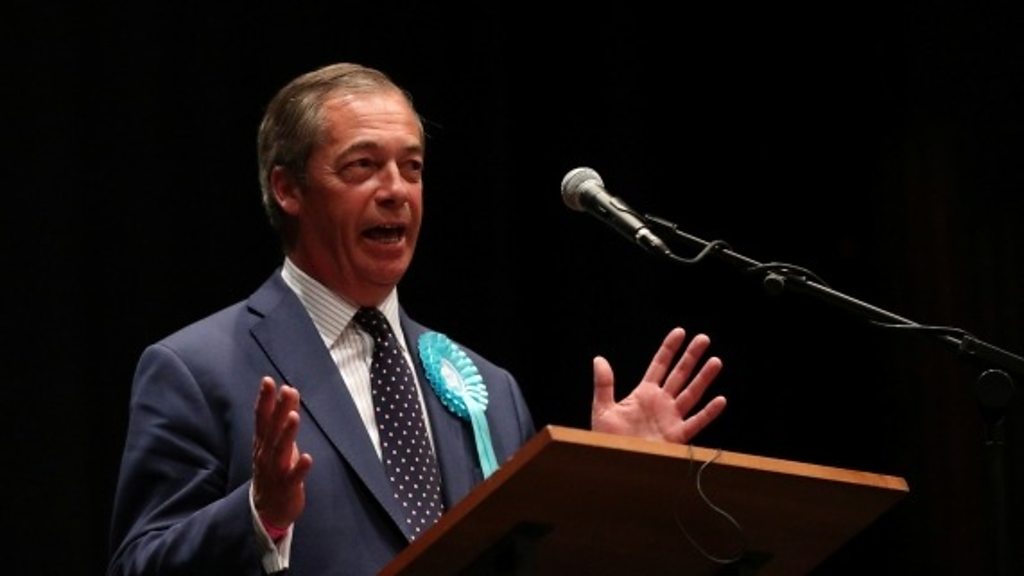
Brexit Party leader Nigel Farage said the two main parties “could learn a big message” from the results.
Overall, out of 64 MEPs declared, Mr Farage’s party has won 28, the Lib Dems 15, Labour 10, Greens seven, the Tories three and Plaid Cymru one.
All 28 EU member states are electing MEPs.
The UK had been due to leave the EU on 29 March, but when that deadline was missed, participation in the election became mandatory.
Scotland is yet to formally declare, but with most votes counted, the SNP is on course for a resounding victory, with around 38% of the vote.
The Brexit Party dominated in Wales, with Plaid Cymru second. Meanwhile, Northern Ireland’s count does not begin until Monday, with the results expected on Tuesday.
Polling expert Sir John Curtice said the results showed just how polarised the country had become.
BBC political editor Laura Kuenssberg said this has been the worst performance for the Conservatives as a party going back to 1832.
“If this was a first-past-the-post election, they would not have taken a single seat,” she said.
So far:
- The UK is electing 73 MEPs and 10 out of 12 regions have so far declared
- The Brexit Party has received the highest share of the vote in nine of the 10 regions – it is heading for first place overall, with about a third of the vote
- The Conservative Party has been widely rejected by the electorate and is heading for fifth place
- The Lib Dems have taken second place with 20% of the vote – a vote that is clearly much higher in areas that backed Remain. In London, the Lib Dems came first and the Tories fifth
- The Green Party has also made gains, seeing its best performance since 1989
- Newly-formed Change UK has not won any seats, while UKIP has also haemorrhaged support to The Brexit Party – both will likely gain about 3% of the vote
- The Labour Party has fallen to third place overall – fifth in Scotland – and is on course to end up with less than 15% of the vote, an even worse performance than the previous low in 2009
A modern browser with JavaScript and a stable internet connection is required to view this interactive.
Click here for full UK results
The results for your area are not in yet
Conservative MP Helen Whately told the BBC her party had been expecting a bad night.
“We wanted to have left Europe by now. It is frustrating for us and for people who usually vote Conservative,” she said.
Brexiteer Tory Mark Francois said The Brexit Party had “romped it”.
Labour leader Jeremy Corbyn said the elections had “become a proxy second referendum” after the Conservative’s failue to deliver Brexit.
He said his party would “reflect on these results on both sides of the Brexit divide” and the issue “will have to go back to the people” through a general election or a public vote.
Labour’s deputy leader Tom Watson said the party needed to “urgently” re-think its Brexit position after the “disastrous” election results.
Alastair Campbell, former spin doctor to Tony Blair and prominent member of the People’s Vote campaign for another referendum, said for the first time in his life he had voted for the Lib Dems.
Media playback is unsupported on your device
Media playback is unsupported on your device
In contrast to the two biggest parties, smaller ones with an unambiguous message on Brexit were rewarded.
Lib Dem Sir Ed Davey said his party was “leading the Remain vote” and had “an awful lot to be pleased about”.
Change UK leader Heidi Allen told the BBC her party was “down, but we are not out”, and agreed there had been a “massive swing to Remain”.
Analysis: By polling expert Prof John Curtice
It’s probably best read as approximating to a draw – between the Remain and Leave sides, that is. (I’m leaving out the nationalists.)
Two parties, both in favour of leaving without a deal overwhelmingly almost entirely supported by Leave voters: The Brexit Party and UKIP. Total vote: 35%
Three parties: the Liberal Democrats, the Greens and Change UK, all in favour of another referendum. Total vote: 35%.
I think the oddest truth is that what this election has done is two things.
One is to demonstrate just how polarised the public are on this issue.
The second is to remind us, as the opinion polls have been telling us, that support for Remain and support for Leave are still very close to each other.
The Brexit Party polled an average of 44% of the vote in council areas where more than 55% voted to Leave in 2016.
In areas where less than 45% voted Leave, the Lib Dems averaged 50% of the vote.
Figures suggest that the turnout in some areas rose sharply, while others saw a fall compared with the last election in 2014.
Wales saw the highest increase in turnout, with a five percentage point increase to 37.3%. The South East, South West and North East also saw a boost in the number of people casting their vote.
But in Northern Ireland turnout fell nearly six percentage points to 45.1%, while smaller drops were also recorded in the West Midlands, North West and Eastern regions.
Both of our big main parties are being punished severely for the meltdown in Westminster over Brexit.
The flip-side for the smaller parties? The Lib Dems are buoyant and of course, Nigel Farage is back with a vengeance.
A European election may not be a direct proxy for a UK general election, but nevertheless, after tonight, millions of voters in regions up and down the country will be represented by parties other than the big two.
It also casts doubt on the idea that compromise can win out. Instead, the clear message seems to be that people want clarity – whether that be Leave or Remain – when it comes to Brexit.
Leavers want to Leave, Remainers want to Remain, and efforts to persuade people they should back something in the middle have failed.
Find your council
Search using your postcode or council name or click around the map to show local results